DJI Mavic 3T vs Matrice 30T vs Matrice 4T: Which Thermal Drone Is Right For Inspection Work?
If you are building or upgrading a thermal inspection practice around DJI hardware, three platforms tend to come up quickly: the DJI Mavic 3T, the DJI Matrice 30T, and the DJI Matrice 4T.
All three are capable thermal inspection drones. All three can capture radiometric thermal still images. All three are used by working inspectors across solar, roofing, building envelope, utility, public safety, and infrastructure workflows. But they are not interchangeable. They differ meaningfully in size, ruggedness, visual imaging capability, thermal modes, rangefinding, redundancy, and price.
Here is how they compare:
Mavic 3T Entry-level compact | Matrice 30T Rugged workhorse | Matrice 4T New compact flagship 2025 | |
|---|---|---|---|
Thermal sensor | |||
Native resolution | 640×512 | 640×512 | 640×512 |
Super-resolution | — | 1280×1024 | 1280×1024 |
Temp range | High Gain: −20°C to 150°C | High Gain: −20°C to 150°C | High Gain: −20°C to 150°C |
Measurement accuracy | ±2°C or ±2% | ±2°C or ±2% | ±2°C or ±2% (High Gain) |
RGB imaging | |||
Cameras | Wide (48MP) + tele (12MP) | Wide (12MP) + zoom (48MP) | Wide (48MP) + mid-tele (48MP) + tele (48MP) |
Max hybrid zoom | 56× | 200× | 112× |
Laser rangefinder | — | 1,200 m | 1,800 m |
Performance | |||
Flight time | 45 min | 41 min | 49 min |
Transmission | O3 Enterprise · 15 km | O3 Enterprise · 15 km | O4 Enterprise · 25 km |
Weight | 920 g (1,050 g MTOW) | 3,770 g | 1,219 g |
Operating temp | −10°C to 40°C | −20°C to 50°C | −10°C to 40°C |
Reliability & features | |||
Weather rating | — | IP55 | — |
Built-in RTK | Optional add-on module | ✓ Standard | ✓ Standard |
Redundant systems | — | Dual IMU, baro, RTK · hot-swap batteries | — |
Price & best for | |||
Price (approx. USD) | ~$3,700–4,000 | ~$9,000–10,000 | ~$7,000 |
Best for | Budget-conscious operators, multi-site mobility, controlled conditions | All-weather and mission-critical work, long-standoff inspection | Upgraders from M3T, operators wanting maximum compact capability |
Specs should always be checked against DJI’s current documentation and your local dealer configuration before purchase, especially for bundles, accessories, and region-specific availability.
The Three Platforms at a Glance
DJI Mavic 3T
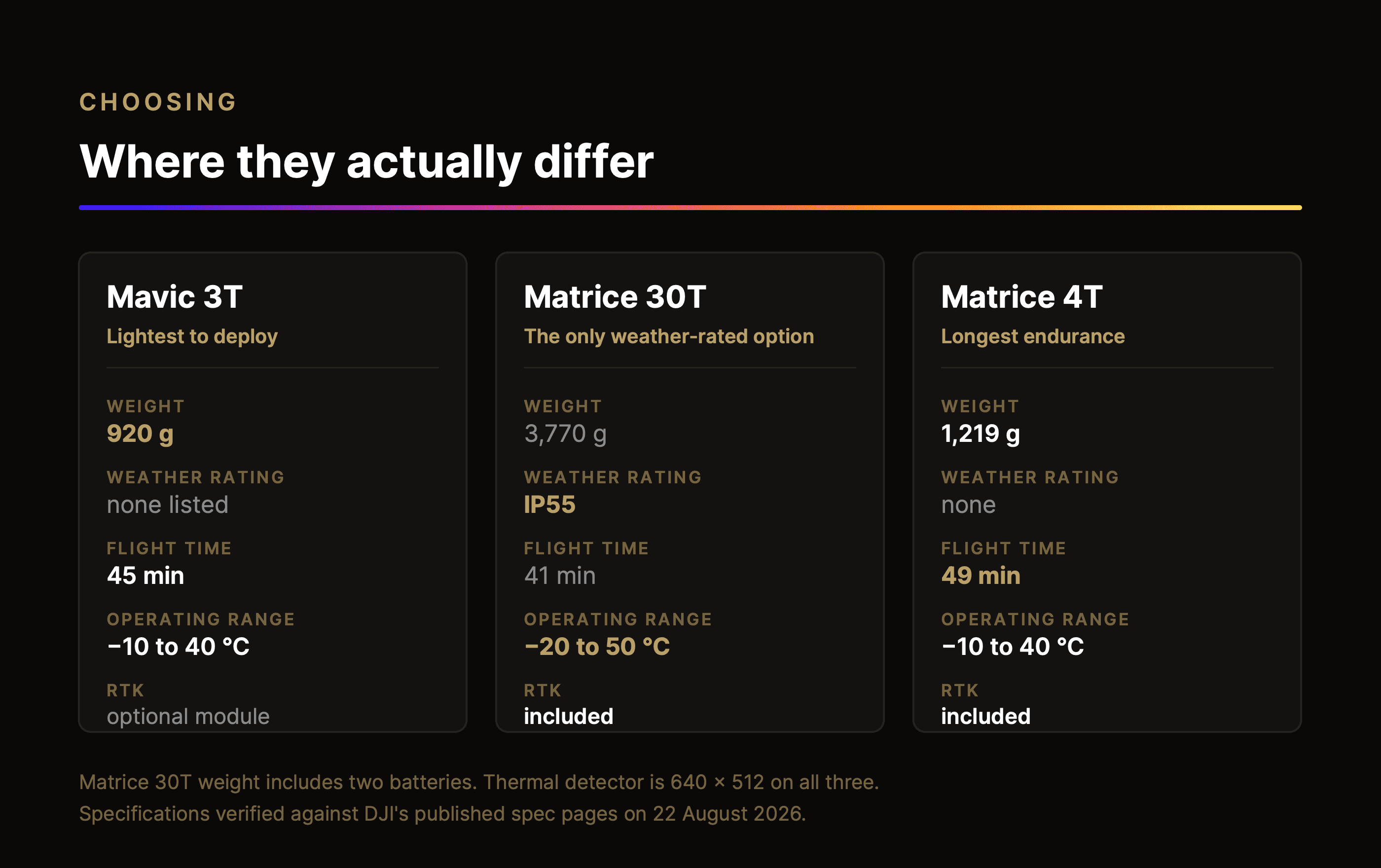
The Mavic 3T is DJI’s compact thermal enterprise drone. It folds small, deploys quickly, and pairs a 640 x 512 thermal camera with a 48 MP wide camera and a 12 MP tele camera with 56x hybrid zoom. Its biggest advantages are portability, lower cost of entry, and ease of deployment. For many independent inspectors, roof surveyors, solar inspectors, and building envelope professionals, the Mavic 3T is still the simplest way into DJI radiometric thermal work. Its tradeoffs are ruggedness and system depth. DJI does not publish an IP rating for the Mavic 3T, RTK requires an optional module, and the platform does not have the same redundancy architecture as the Matrice 30T.
DJI Matrice 30T
The Matrice 30T is the rugged enterprise workhorse. It is much larger than the Mavic 3T or Matrice 4T, but it brings IP55 ingress protection, a -20 C to 50 C operating temperature range, dual batteries, built-in RTK, a 1,200 m laser rangefinder, 200x hybrid zoom, and a proven role in public safety, utilities, infrastructure, and critical inspection work. The M30T is the choice when weather resistance, mission reliability, and standoff inspection matter more than compactness.
DJI Matrice 4T
The Matrice 4T is DJI’s newer compact flagship enterprise thermal platform, announced in January 2025. It keeps the compact deployment advantage closer to the Mavic class while adding a much stronger integrated sensor package: three 48 MP RGB cameras, a 640 x 512 thermal camera with 1280 x 1024 super-resolution modes, a 1,800 m laser rangefinder, built-in RTK, O4 Enterprise transmission, and smart detection features.
Its main limitation compared with the M30T is ruggedness. DJI lists the Matrice 4T gimbal protection as having no standard protection level, and the aircraft operating temperature is -10 C to 40 C. It is a very capable compact inspection platform, but it is not the same all-weather aircraft as the M30T.
Thermal Sensor: Similar Native Resolution, Different Modes
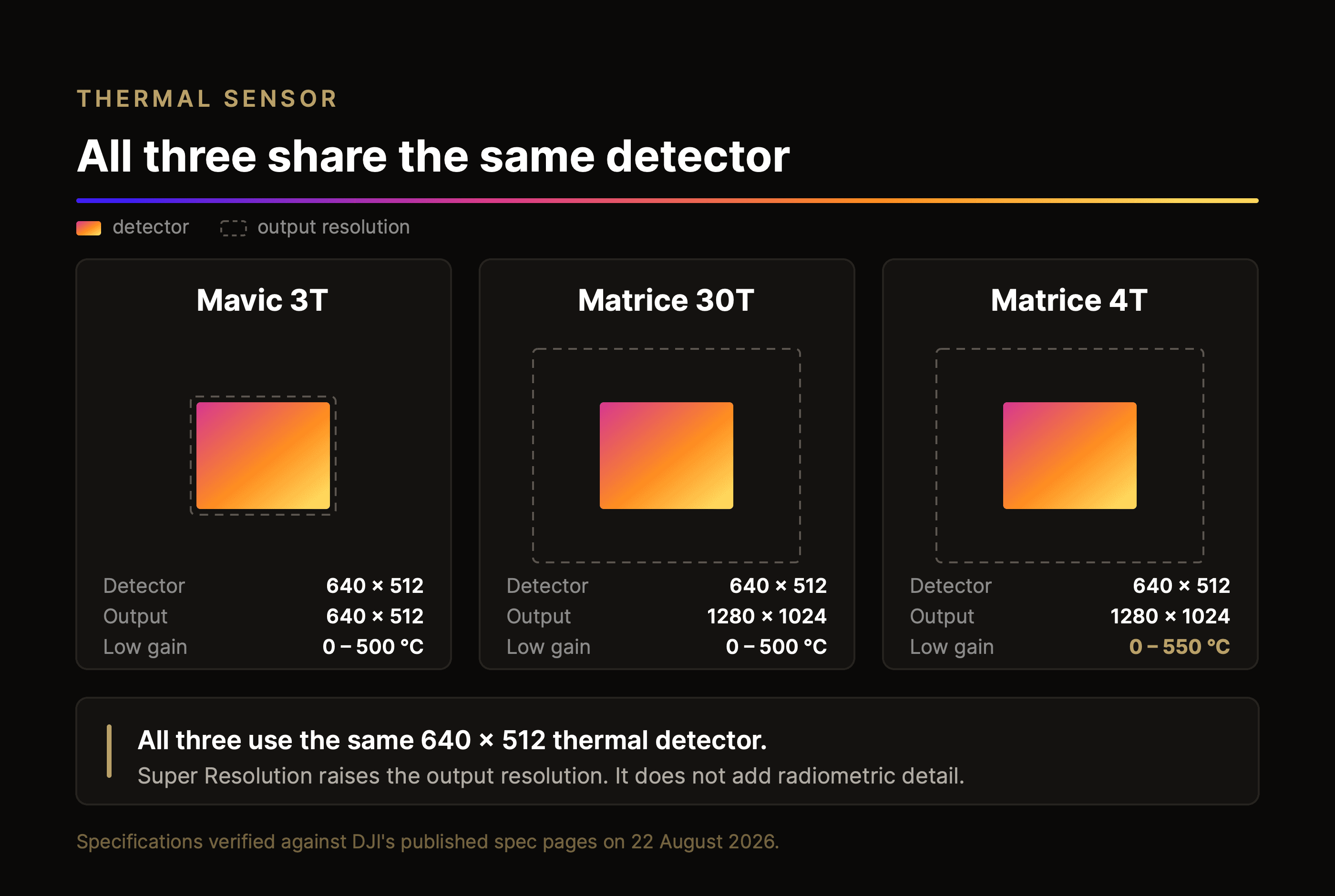
All three platforms are built around 640 x 512 thermal imaging. For many inspection workflows, that native resolution is enough. Roof inspections, solar surveys, building envelope reviews, HVAC checks, and many commercial asset inspections depend as much on flight planning, altitude, ground sample distance, viewing angle, and reporting method as they do on raw sensor resolution.
The difference is in the modes and supporting platform.
The Mavic 3T captures 640 x 512 thermal stills and supports JPEG and R-JPEG photo formats. Its thermal range is -20 C to 150 C in high gain and 0 C to 500 C in low gain.
The Matrice 30T supports 640 x 512 normal thermal imaging and 1280 x 1024 infrared image super-resolution. Its thermal range is also -20 C to 150 C in high gain and 0 C to 500 C in low gain.
The Matrice 4T supports 640 x 512 native thermal imaging and 1280 x 1024 super-resolution for thermal photos and video under supported conditions. Its low-gain range extends to 550 C, giving it a little more headroom for high-temperature applications.
For most inspection businesses, the difference will not be “which one can do thermal inspection?” All three can. The better question is whether your work needs super-resolution, higher temperature range, compact deployment, weather resistance, or a more rugged mission platform.
RGB Imaging: Where The Matrice 4T Stands Out
Thermal inspection reports often depend on visible imagery as much as thermal imagery. Clients need to understand what asset, panel, roof area, facade, or component they are looking at.
The Mavic 3T has a 48 MP wide camera and a 12 MP tele camera with 56x hybrid zoom. That is a strong portable setup for general inspection documentation.
The Matrice 30T has a 12 MP wide camera and a 48 MP zoom camera with 200x hybrid zoom. For long-standoff inspections, such as utility lines, towers, public safety scenes, or inaccessible assets, that zoom range is a real advantage.
The Matrice 4T has the most flexible compact RGB package: a 48 MP wide camera, 48 MP medium tele camera, and 48 MP tele camera, with 112x hybrid zoom. The 70 mm equivalent medium tele camera is especially useful for inspection work because it gives a cleaner middle focal length between wide context shots and long zoom detail.
If your work depends heavily on visual documentation alongside thermal findings, the Matrice 4T is a major step up from the Mavic 3T.

Portability And Deployment
The Mavic 3T is the portability winner. DJI lists it at 920 g with propellers and no accessories, with a maximum takeoff weight of 1,050 g. It folds small and is easy to move between multiple sites in a day.
The Matrice 30T is much larger at 3,770 g with two batteries and a maximum takeoff weight of 4,069 g. It requires a more deliberate transport and deployment workflow, but that bulk buys ruggedness and mission capability.
The Matrice 4T sits in the middle. DJI lists it at 1,219 g with propellers and a maximum takeoff weight of 1,420 g. It is much closer to the Mavic 3T than the M30T in field handling, while carrying a more capable sensor package.
Weather Resistance
This is the Matrice 30T’s clearest advantage. DJI lists the M30T with an IP55 ingress protection rating and an operating temperature range of -20 C to 50 C. For operators in cold climates, dusty environments, light rain, public safety, utilities, or infrastructure inspection, that matters.
The Mavic 3T does not have a published DJI IP rating and is listed for -10 C to 40 C operation.
The Matrice 4T is also listed for -10 C to 40 C operation. DJI lists the gimbal’s ingress protection rating as having no standard protection level.
If you need to fly when conditions are poor, the Matrice 30T is the clear choice. If you can schedule inspections around weather, the Mavic 3T and Matrice 4T remain very capable fair-weather platforms.
Flight Time
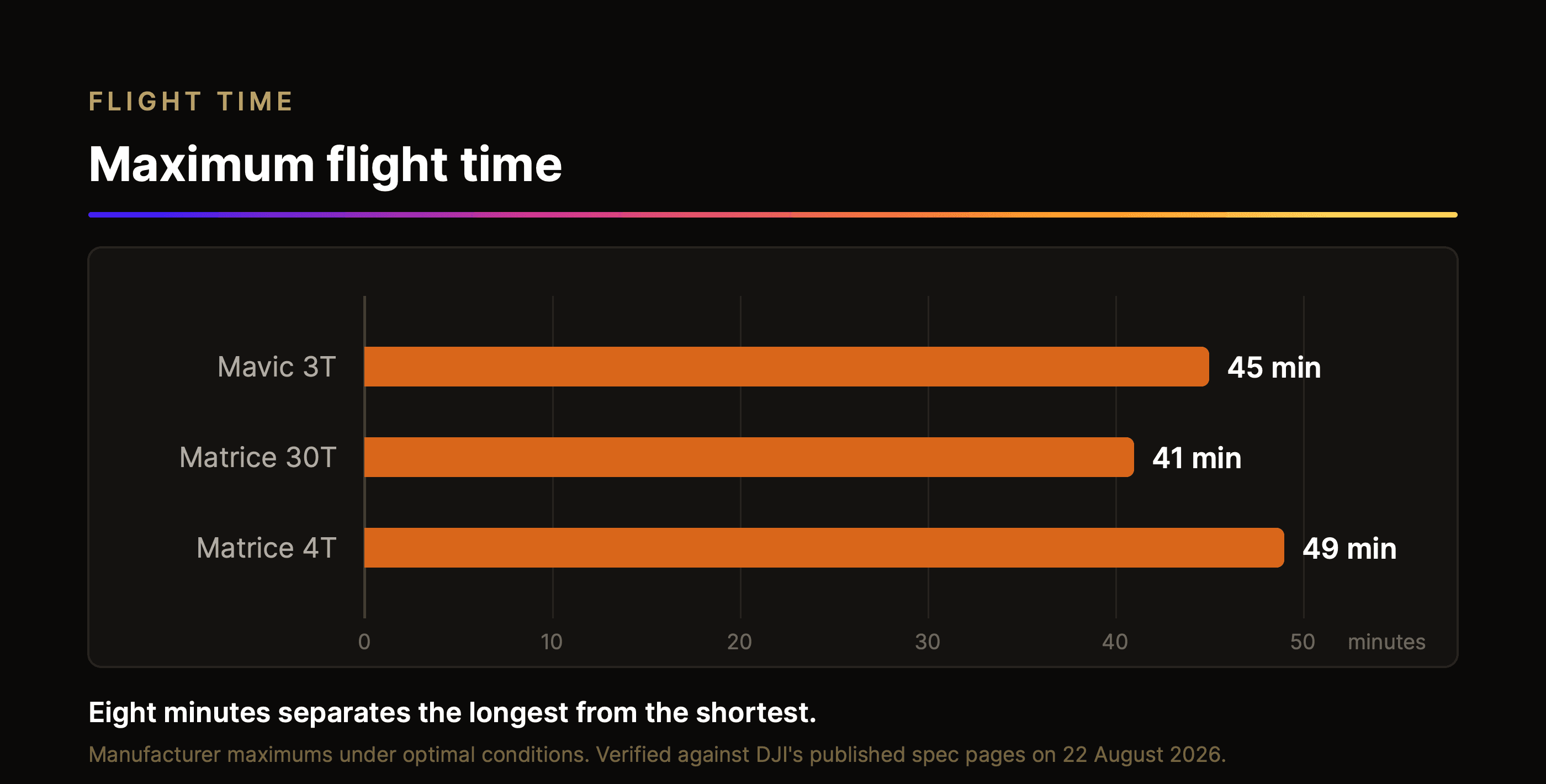
All three platforms are competitive. DJI lists maximum flight time as 45 minutes for the Mavic 3T, 41 minutes for the Matrice 30T, and 49 minutes for the Matrice 4T. Real-world inspection time will be lower depending on wind, flight profile, temperature, battery age, payload, and reserve requirements. But none of these platforms is unusually weak on endurance for typical inspection work.
RTK And Location Accuracy
RTK matters when you need accurate geotagging, repeatable inspection routes, or precise location references for findings.
The Mavic 3T supports RTK through an optional module. That keeps the aircraft compact and flexible, but adds cost and setup when centimeter-level positioning is needed.
The Matrice 30T has built-in RTK positioning capability.
The Matrice 4T also has RTK positioning capability built into the platform.
If location accuracy is central to your workflow, the M30T and M4T have the cleaner default setup.
Reliability And Redundancy
This is where the Matrice 30T earns its enterprise reputation. The M30T runs on two TB30 batteries, supports hot swapping through its battery system workflow, and is built for demanding field operations. DJI also positions the M30 series around mission reliability, with IP55 protection, wide operating temperature range, obstacle sensing, RTK, and enterprise transmission.
The Matrice 4T has strong sensing, O4 Enterprise transmission, built-in RTK, and modern intelligent features, but it is best understood as a newer compact inspection platform rather than a more rugged replacement for the M30T.
The Mavic 3T is capable and widely useful, but its redundancy profile is closer to a compact enterprise aircraft than a critical-mission platform. For controlled inspection work, that is often fine. For missions where weather, public safety, or asset criticality make reliability the overriding concern, the M30T is the stronger fit.
Which One Should You Choose?
Choose the Mavic 3T if you want the best value and portability.
The Mavic 3T is the practical choice for inspectors entering professional thermal work, operators who work primarily in controlled conditions, and teams that need a compact aircraft for roof, solar, building envelope, HVAC, and general commercial inspection.
It gives you legitimate radiometric thermal capability without the size, cost, or operational overhead of a Matrice platform.
Choose the Matrice 30T if you need ruggedness and mission reliability.
The M30T is the right choice when weather resistance, low-temperature operation, long-standoff zoom, dual-battery architecture, and mission hardening matter more than portability. For utilities, public safety, infrastructure, industrial sites, and inspection teams that cannot simply wait for ideal weather, this is the platform that justifies its premium.
Choose the Matrice 4T if you want the strongest compact inspection platform.
The M4T is the natural choice for operators who want a modern compact platform with stronger RGB imaging, thermal super-resolution modes, built-in RTK, a 1,800 m laser rangefinder, and O4 Enterprise transmission. It is especially compelling for inspection teams that want more capability than the Mavic 3T but do not need the M30T’s IP55 ruggedness.
The Short Version
The Mavic 3T is the portable value choice.
The Matrice 30T is the rugged, critical-mission choice.
The Matrice 4T is the modern compact capability choice.
The right drone depends less on thermal resolution alone and more on how you actually work: weather, inspection type, client expectations, travel, operating conditions, and how much visible documentation you need alongside the thermal data.
Processing Your Imagery On Mac
Whichever platform you fly, the challenge after the inspection is the same: turning DJI thermal imagery into a structured, client-ready report.
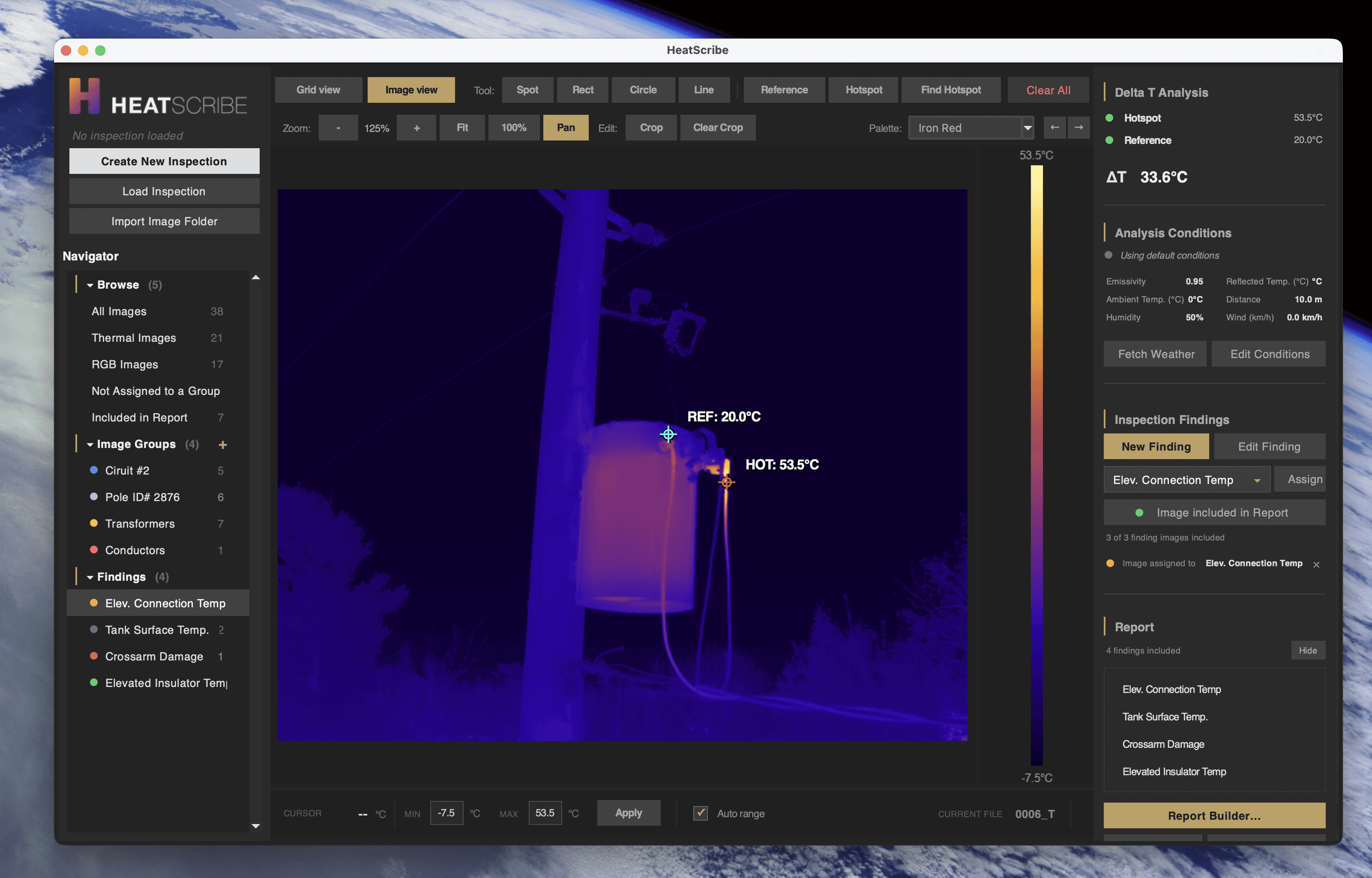
HeatScribe is a native macOS application built for DJI thermal inspection and reporting. It processes DJI radiometric imagery using the official DJI Thermal SDK, working from radiometric data that can be used to calculate per-pixel temperature measurements when decoded correctly. HeatScribe guides you through image review, thermal analysis, Delta T findings, structured documentation, and PDF report generation in a single Mac workflow.
If you are flying a Mavic 3T, Matrice 30T, or Matrice 4T and doing your analysis and reporting on a Mac, HeatScribe was built for exactly that workflow.
Sources:
Three DJI thermal platforms, three different use cases. A no-fluff comparison of the Mavic 3T, Matrice 30T, and Matrice 4T for inspection operators.